

The Wear Rate Estimate tool is designed to estimate the Linear Wear Rate Constants for a ball charge in a Conventional Ball Mill, based on its known dimensions and basic operating conditions. Additionally, this tool allows for the calculation of typical Grinding Media Consumption Rate indicators, including gr/t, gr/kWh, kg/hr, or tons/month.
The most widely accepted mathematical description of the gradual consumption process experienced by a grinding ball inside a tumbling mill is known as the Linear Wear Theory. According to this theory, the mass rate of consumption of a grinding ball is directly proportional to the surface area exposed by the ball to the various wear mechanisms (abrasion and/or corrosion) active in the mill charge environment:
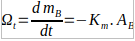
Where:
Equivalently, taking into account the geometry of the grinding body (sphere or cylinder), the wear rate is described as:
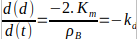
Where:
If kd remains unaffected by the extent of wear (a condition known as Linear Wear Kinetics), the above expression can be integrated to obtain:
d = dR - kd t
Where dR represents the initial size of the balls. For any given grinding media variety, the constant kd serves as an indicator of its relative quality compared to other alternatives.
By analogy to mineral particle breakage kinetics, an even more representative and scalable quality indicator is the Energy Specific Wear Rate Constant [kdE, µm/(kWh/t)], defined as:

Where the ratio (Pb/Wb) corresponds to the contribution (Pb) of every ton of balls in the charge (Wb) to the net power draw (Pnet) of the mill.
The underlying theoretical claim is that grinding balls will wear faster in a more energy intensive environment. Therefore, kdE is expected to be more insensitive than kd to variations in mill operating conditions (that may affect Pb and/or Wb). As a practical evaluation criterion, it should be then accepted that the top quality grinding media, in any given application, will be the one that exhibits the lowest value of the wear rate constant kdE. The above expression creates the need for a theoretical representation of the Mill Power Draw and how each component of the mill charge (balls, rocks and slurry) contribute to this power demand. The simple Hogg and Fuerstenau model serves such purpose well (see Spreadsheet Mill Power_Ball Mills).
Then the traditional Grinding Media Consumption Indicators may be obtained from the expressions:
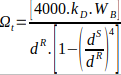
Where de dS represents the average size of the metal scrap being rejected by the mill.
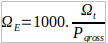
, in g/kWh

Where E is the specific energy, given in kWh/t.
Recently, H. Benavente (Moly-Cop 2006 : X Simposio sobre Procesamiento de Minerales, Termas de Chillán, Chile) proposed an empirical correlation for the calculation of kdE, as a function of the Bond's Abrasion Index (54th Annual Meeting of AICHE, 1963) of the ore, the F80 feed size and the slurry pH, where de KDB is the Benavente constant.
