

The Media Charge_Wear & Impact_SAG Mills tool is designed to evaluate the intrinsic parameters that determine the grinding media consumption rate in any given SAG milling operation, considering both normal wear and impact breakage mechanisms.
The most widely accepted approach to characterize the sustained consumption (wear) kinetics of grinding bodies in rotary tumbling mills is known as the Linear Wear Theory. According to this theory, at every instant 't' after the grinding body was added to the mill charge, its rate of weight loss is directly proportional to its surface area exposed to gradual abrasion and/or corrosion mechanisms:
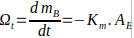
Where:
Equation 1 transforms into:
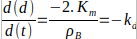
Where:
For full-scale mills, to maintain constant grinding media inventory, operators periodically recharge new balls, preferably of a single size (dR). The total grinding media consumption rate (Ωt) is proportional to the total exposed area (A):
Ωt = - km A = - ρb kd A / 2
The exposed area (A) is calculated as:
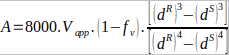
Where:
The wear rate constant (kd) can also be represented by kdE [µm/(kWh/t)]:

Here, Pnet of the mill is expressed as:
Pnet = η Pgross = 0.238 D³⁵ (L/D) Nc ρap (J - 1.065 J²) sinα
Where:
The apparent density of the charge (ρap) is evaluated based on the indicated charge components (balls, interstitial slurry, and overfilling slurry):
\[ \rho_{\text{ap}} = \frac{ \left[ \left( 1 - F_v \right) \cdot \rho_B J_B + \rho_p J_p F_v J_B + \rho_p \left( J - J_B \right) \right] }{J} \]
Where:
The contribution to the net mill power (kW) by the balls in the charge is given by:
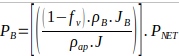
In operations where noticeable ball breakage is to be expected – like in high-impact, SAG applications – an expanded, conceptual model, based on pilot Drop Ball Testing (DBT) results has been proposed to incorporate breakage as a potentially significant grinding media consumption mechanism.
The DBT is a standard, pilot scale testing procedure, originally designed by the U. S. Bureau of Mines to assess the resistance of any given sample or lot of balls to repeated severe ball-to-ball impacts. Briefly, the DBT facility consists of a 10 m-high, J-shaped tube of slightly larger internal diameter than the size of the balls being tested. The curved, bottom part of the tube is filled with a constant number of balls (for instance, 24 when testing 5" balls). When another ball is dropped through the tube from a height of 10 m above, the top ball retained below in the tube suffers the direct impact of the falling ball, which is replicated through the whole line of balls retained in the curve at the bottom of the J-tube, originating the removal (through the lower tip of the J-tube) of the first ball in the line, which is so replaced by the last ball dropped.
The balls removed from the tube are continuously lifted – via a bucket elevator – back to the top of the tube to be dropped down once again. The DBT is run until a certain maximum number of balls are broken (say, 10 broken balls) or a reasonable number of total cycles have been completed (say, 20,000 drops). The main outcome of a DBT test is the Average Breakage Probability, DBTstd, simply calculated as:

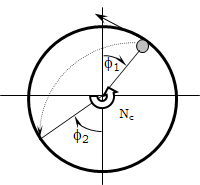
With reference to Figure 1, in a full scale mill, the most critical, outer trajectory of a ball is that of a ball of mass m being lifted to a position defined by the angle φ1 in the upper-right quadrant of the section of a mill of diameter D (ft) and then allowed to free-fall down to impact the toe of the mill charge ‘kidney’ at a position φ2, in the lower-left quadrant.
In such case, the associated impact energy may be estimated by:

The equivalent DBT height to attain equal impact energy at both scales (pilot and industrial) is then obtained as:

Then, for projecting the DBTstd ball breakage probability to full industrial scale mills, the standard test value should be corrected as follows, for every ball size 'd':
