
The Mill Power Draw tool is designed to estimate the Net and Gross Power consumption (kW) of a conventional tumbling mill, as a function of its known dimensions and basic operating conditions.
The Net Power consumption of a conventional tumbling mill may be well estimated by the simple Hogg and Fuerstenau Model (“Power Relations for Tumbling Mills”, Trans. SME-AIME, Vol. 252, pp. 418-432, 1972). This model has been expanded to represent the independent contribution of each component of the mill charge (balls and slurry) to the total net power draw of the mill:

Where:
The apparent density of the charge (ρap) is evaluated based on the indicated charge components (balls, interstitial slurry, and overfilling slurry):
\[ \frac{ \rho_{\text{ap}} = \left[ \left(1 - F_v\right) \right] \cdot \rho_B J_B + \rho_p J_p F_v J_B + \rho_p \left(J - J_B\right) }{ J } \]
Where:
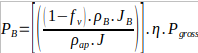
The contribution to the net mill power (kW) by the balls in the charge is given by:
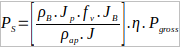
Similarly, the contribution to the net mill power (kW) by the interstitial slurry is:
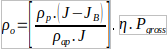
The normally negligible contribution of the overfilling/Rocks (kW) slurry on top of the charge is: